

Meet Hania, SITIC 2014 award winner
The young Chadian-American developed “Water Saver”, a system that optimises the use of scarce resources such as water and fertiliser. Interview.
Translated from French. Lire en français
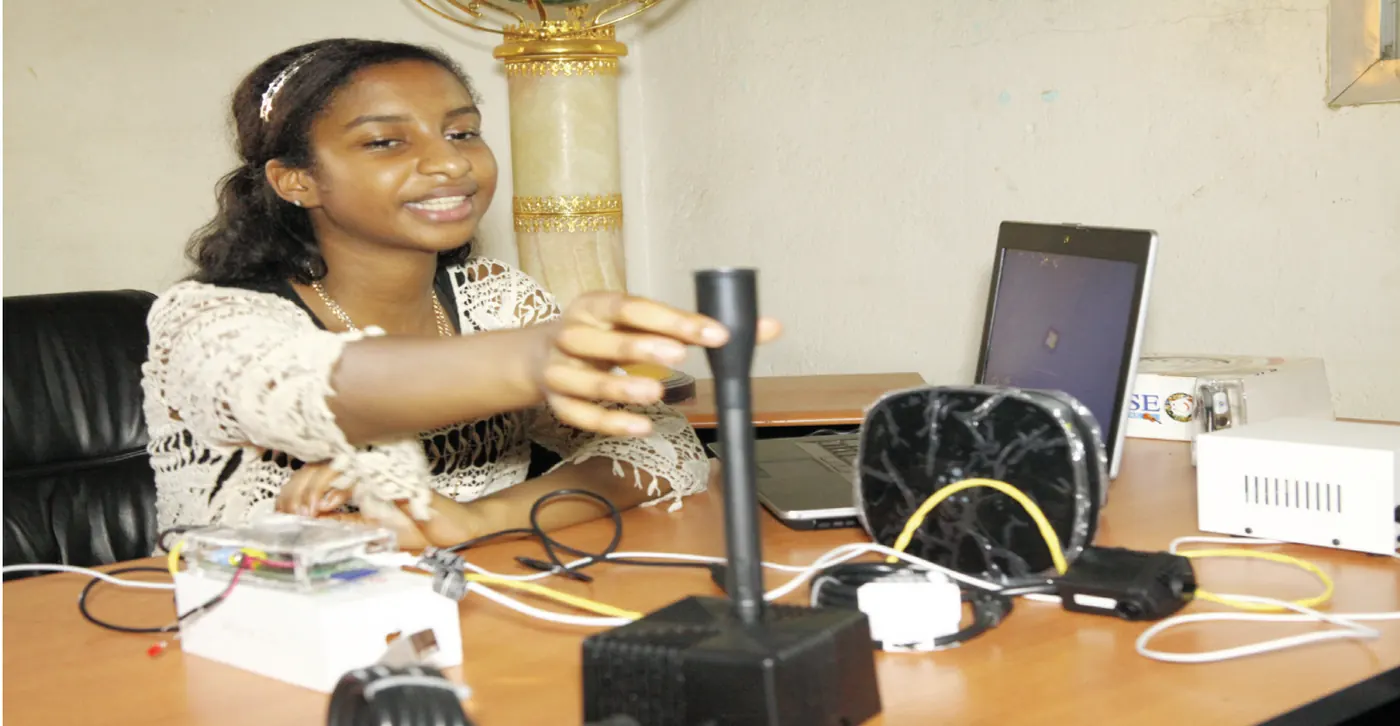
“I developed a system called ‘Water Saver’ that optimises the use of scarce resources such as water and fertiliser. It avoids watering plants or irrigating except when necessary. We use moisture and temperature sensors placed in the soil. They are connected to a low-cost gateway (a Raspberry Pi), where my program, written in the Java programming language, analyses environmental data in real time and stores it on a standard memory card.
The prototype monitors two thresholds (upper and lower), calculates an average of current values, then decides whether to open or close the water supply. The system works in two modes, manual and automatic. In manual mode, the user decides when to open or close the water supply; in automatic mode, my program controls the water level. It is a very low-cost system, simple to use and accessible from home, from work or anywhere else with a smartphone, a tablet or a computer connected to the internet or the cloud.”
What motivated you to work on such an innovative project?
Two current issues. The disappearance of Lake Chad: its gradual shrinking, caused by climate effects and excessive irrigation, has had a dramatic impact on everything that grows and lives around the lake — farming, livestock, fishing, and even soil salinity. This has increased poverty across a region covering at least six countries. That is why optimising water use must be a development priority in Chad and in all the other countries bordering the lake.
The drought in California: thousands of kilometres from Lake Chad, on 17 January 2014, Governor Jerry Brown formally declared a drought emergency in California — the worst the Golden State had seen in a hundred years. The declaration allowed California to ask President Obama to approve water transfers, financial assistance and the suspension of restrictive federal and state laws. California is in a dire situation and needs every drop of rain it gets.
How did your parents react to your choice?
My parents are the reason for this achievement. They were the first to encourage me to work on the project. My father agreed without hesitation to be my technical coach, and my mother gave me moral support and a lot of encouragement through the difficult moments.
What motivated you when you started your research?
At first, my school, which encouraged us to take part in a local science fair. Our engineering teacher also promised to add 3% to our final grades if our team came first, second or third in the county competition. We also had to find an experienced engineer in the field: my father agreed to mentor my classmate and me. He also promised to double the prize if we won one of the top three awards.
Did you imagine your work would receive such recognition?
Not at all. I was doing it for fun. I started the project for a local science fair, in the engineering and mathematics category, hoping to win one of the 300 prizes the county awards each year. I never imagined winning at such a high level, meeting several heads of state and being recognised by my president as a role model for Chadian girls and for Chadians in general. It made me proud of myself, of my roots and of my country, Chad. It also allowed me to meet such a wonderful people and an extraordinarily warm young audience.
Can you tell us about your mother?
Thank you for the question — I cannot finish without thanking my mother, Amouna Mahamat Alio. She is my role model and my first teacher of Chadian culture. Without her, I would speak only three languages. Without her, I would be just a Canadian or an American. Thanks to her, I am fully Chadian.
What memories do you have of your visit to your father’s home village?
After SITIC, I wanted to visit Dourbali, the home village of my father’s mother, to see how girls like me live there. I also wanted to share my success with them and encourage the girls there to follow my example and study. Believe me, I was even more surprised, because everyone gave me the most wonderful welcome. A convoy of motorbikes was waiting for me several kilometres before the town. Women, children, young and old, as well as the administrative and religious authorities — including the mayor, the two canton chiefs and the sub-prefect. They all welcomed me as their daughter and expressed their pride in seeing a descendant of the town honour them with this trophy.
The children gave me two symbolic gifts: a pencil and a sheet of paper (for the need to study) and a syringe (for the need for healthcare). That shows my challenges are only just beginning. I must work hard to build them a medical clinic and, above all, a computer centre, as they wish. I also presented the mayor of Dourbali with a gold plaque from the city of San Francisco, as a gift to the town and its people. We handed out T-shirts and caps donated by Oracle to encourage young people to learn technology, and sweets for the children.
What touched me most was the warmth and love of my father’s aunts and grandmothers, who wept with joy as they hugged me. They told me that the last time I visited, I was no bigger than a piece of bread. In the end, what struck me most everywhere in Chad was this sincere, infectious warmth. I am going back to California fulfilled and happy to be an ambassador for my country and its people. Words fail me, but I cannot end without simply saying: “Thank you all.”
- Author:
- Moïse Aignan N.
- Published on:
- Wednesday, 1 October 2014
Related articles
Ernst & Young pursues its corporate citizenship mission with new training sessions
In N’Djamena and then Douala, the firm unpacked the 2025 Finance Act for executives, finance directors, accountants and management controllers.

Total opens new service stations
With three new stations in Hamama, Bongor and Ndjari, Total Marketing Chad brings its network to 12 stations, with 16 targeted by year-end.
Chad: emergence via the information superhighway
The first International ICT Fair (SITIC), held in N’Djamena from 9 to 12 September 2014, brought together many heads of state and international institutions.

The qualities of a good leader according to Marshall
General George C. Marshall had a very clear idea of what he looked for in officers. His seemingly ordinary list deserves a closer look.